
Whale entanglement is one of the most urgent threats facing humpback whales off the coast of San Diego, and in May 2026 our crew witnessed it firsthand. Less than ten miles from Mission Bay, we spotted a humpback whale dragging a lobster trap that had cut deep into its peduncle and tail. In this guide, we explain exactly why whale entanglement happens, the damage it inflicts, and — most importantly — precisely what you should do if you ever spot an entangled whale yourself.

What Is Whale Entanglement in San Diego Waters?
Whale entanglement occurs when a whale becomes wrapped in derelict or actively fished gear — most commonly rope, buoys, or netting from crab and lobster traps — and cannot free itself. Off San Diego, this is exactly what we found during a routine drone flight in May 2026. From the air, we could see a lobster trap line digging painfully into the whale’s peduncle, the narrow muscular section connecting its body to its tail flukes.
As a result, we immediately notified the Coast Guard and forwarded our drone photos to NOAA, Sea World Rescue, and The Large Whale Entanglement Response Network. Afterward, we started asking the same questions every whale watcher eventually asks: why does this keep happening, and what can an ordinary boater actually do to help? The rest of this guide answers both questions in full — including the exact steps to follow if you ever encounter an entangled whale of your own.
Why Do Whales Become Entangled? The Role of Kelping Behavior
Many whales, especially humpback whales (Megaptera novaeangliae), engage in a variety of sensory-seeking and grooming behaviors. Chief among these is a ritual called “kelping,” where a whale rolls itself through thick stands of kelp. The pliable kelp works like a loofah, scrubbing away whale lice and barnacles that build up in the grooves and crevices of its fins. Because kelp is abrasive yet breakable, it offers an easy and pleasant grooming experience shared by adults and juveniles alike.
Unfortunately, kelp beds can hide fishing gear from even the most experienced and wary whales. Lobster and crab traps are frequently placed near kelp beds, since these are rich feeding habitats for a wide range of marine life. Unlike kelp, the monofilament and polypropylene lines used with these traps don’t break — and they can easily tangle with the kelp as a whale tries to groom itself. Consequently, with just a few rolls through nearby strands, a whale can become hopelessly caught, turning a moment of comfort into a life-threatening whale entanglement.
The Devastating Physical Toll of an Entangled Whale
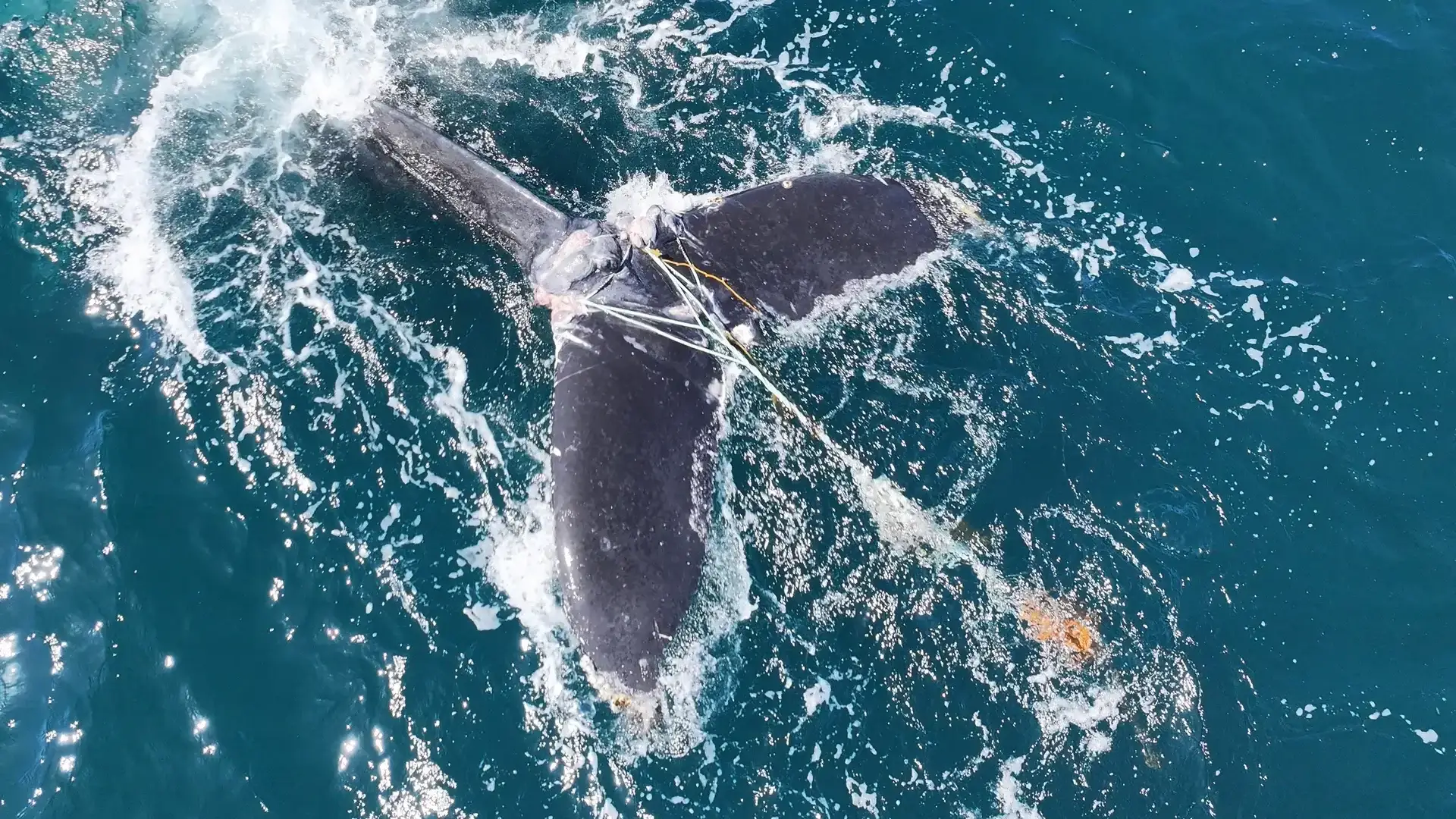
The effects of whale entanglement are both immediate and chronically debilitating. Modern lines used in standing fishing gear are designed not to break, and they often include heavy buoys and floats. As a result, this gear can prevent a whale from diving normally and severely hamper its mobility, making feeding and migration exhausting. In the case we found, lines were already tearing into the flesh around the tail after less than a week of entanglement.
In particular, NOAA Fisheries reports that entanglement in fishing gear ranks among the leading documented causes of serious injury and mortality for large whales along the U.S. West Coast. Over time, untreated wounds can lead to infection, malnutrition, and — in the worst cases — the whale drowning or starving because it can no longer swim, dive, or feed effectively. Above all, this is why fast, accurate reporting matters so much: the sooner a trained team locates an entangled whale, the better its odds of survival.
Whale Entanglement Prevention: Ropeless Gear and Fishery Reforms
Preventing whale entanglement before it happens is just as important as responding to it afterward. In recent years, fishery managers, gear engineers, and conservation groups have developed several tools designed to keep whales and traps apart in the first place.
How Ropeless Fishing Gear Reduces Entanglement Risk
So-called “ropeless” or pop-up gear eliminates the long vertical buoy lines that run from a trap on the seafloor up to a surface float — the exact type of line responsible for the San Diego entanglement described above. Instead, the trap stores a coiled line and a lift bag on the seafloor, and the fisherman triggers it remotely via acoustic signal when it’s time to retrieve the catch. Because no line is left hanging in the water column between sets, a whale rolling through the area has nothing to snag. Several California fisheries are now piloting this technology, though cost and gear-conflict issues have slowed widespread adoption.
Seasonal Closures and Whale-Safe Fisheries in California
In addition to gear innovation, California’s Dungeness crab fishery now operates under a risk-assessment framework that can delay the season’s opening or trigger an early closure whenever whale sightings spike in a given region. Similarly, “trap limits” reduce the total number of lines in the water at once, which lowers the odds that any single whale encounters one. Consequently, these overlapping strategies — better gear, smarter timing, and fewer lines overall — form the backbone of modern whale entanglement prevention efforts up and down the coast.
The West Coast Large Whale Entanglement Response Network
Whale entanglement has been a known hazard for decades, and dedicated teams work year-round both globally and locally to respond. Here in San Diego, the West Coast Large Whale Entanglement Response Team operates alongside Sea World Rescue and NOAA (the National Oceanic and Atmospheric Administration) to monitor reports and mount rescue missions to cut whales free. Despite their best efforts, however, many whales are never located again before they move out of range.
This is exactly where everyday whale watchers come in. As an untrained observer, you cannot legally or safely free a whale yourself — but you can absolutely be the reason a rescue team finds it in time. See our whale watching guide for more on spotting whales responsibly, and keep reading below for the exact information rescuers need from you.
How to Report a Whale Entanglement in San Diego (Step-by-Step)
If you spot an entangled whale, act quickly but stay calm. Report it to the Coast Guard via VHF radio on channel 16, or call the national hotline at 1-877-SOS-WHALE (1-877-767-9425). Follow these steps, in order, to give rescuers everything they need:
- Note the exact location. Record GPS coordinates if possible, or estimate distance and bearing from a known landmark so rescue boats can find the same spot quickly.
- Track its direction and dive pattern. Watch which way the whale is traveling and time how long it stays down between surfacings, since this helps responders predict where it will resurface next.
- Describe the whale itself. Note its approximate size, the presence or shape of a dorsal fin, and any species clues you can safely observe from a distance.
- Describe the entanglement in detail. Mention the color and type of gear involved, and specify exactly where on the body it is wrapped, such as the mouth, flippers, or peduncle.
- Capture clear photos or video. Shoot from a safe, legal distance using a zoom lens or drone whenever possible, since sharp images help responders plan the safest cutting approach.
- Stay nearby if it’s safe to do so. Maintaining visual contact — from a respectful distance — can be the single biggest factor in whether a rescue team relocates the whale at all.
Why You Should Never Attempt a Whale Rescue Yourself
Any attempt to free an entangled whale must be carried out by a trained and federally permitted team, both to prevent further harm to the whale and to protect the would-be rescuer. Indeed, even trained, permitted rescuers have been injured — and in rare cases killed — during whale disentanglement attempts, because a panicked, multi-ton animal thrashing in gear is genuinely dangerous. Therefore, the single most valuable thing an untrained observer can do is report, document, and step back.
For those who feel called to do more, there is a legitimate path forward. Specifically, you can train through the official West Coast Large Whale Entanglement Program, which certifies volunteers and professionals to safely assist in real disentanglement operations under NOAA authorization.
What Happened to the Whale We Found?
We successfully reported the whale pictured above, first described in this blog, to the San Diego Sea World Rescue team. This individual was later rescued, thanks in large part to the coordinated efforts of the West Coast Large Whale Entanglement Program. In other words, the report you file really can be the difference between life and death for a whale you may never see again.
Having a boat and a drone was a strong start, but we’re now training to provide better, more comprehensive help to entangled and struggling whales in the future. Ultimately, no meaningful improvement in the plight of our marine wildlife happens without the coordinated efforts of the people who love them — boaters, rescuers, and everyday whale watchers alike.
How Whale Watching Trips Help Spot and Report Entangled Whales
Because trained naturalists and experienced captains spend hours on the water every week, they’re often the first to notice a whale swimming or diving abnormally. Joining our San Diego whale watch tours puts you alongside crew members who know exactly what a healthy dive pattern looks like versus a labored one — the kind of subtle difference that flags a possible whale entanglement long before it’s obvious to a casual observer.
For example, our guide to the best San Diego whale watching tips and locations covers exactly where and when humpbacks feed most actively along our coast, including the seasonal humpback whale feeding bonanza that draws dozens of whales into local waters each year. Similarly, guests on our snorkel safari with San Diego’s Mola molas frequently spot marine life in the same kelp-adjacent zones where entanglement risk runs highest, making every trip a chance to help monitor these waters.
Frequently Asked Questions About Whale Entanglement
What should I do if I see a whale entanglement in San Diego?
Immediately call the Coast Guard on VHF channel 16 or dial 1-877-SOS-WHALE (1-877-767-9425). Provide the whale’s location, direction of travel, a description of the gear, and photos or video taken from a safe distance.
How can I tell if a whale is entangled?
Look for visible rope, buoys, or netting trailing from the mouth, flippers, or tail. Entangled whales often swim slowly, surface abnormally, or struggle to dive normally compared to nearby whales.
Is it safe to try to free an entangled whale myself?
No. Only trained, federally permitted responders should attempt disentanglement. Even experienced rescuers have been seriously injured, so untrained boaters should report and observe from a safe distance instead.
What number do I call to report a whale entanglement?
Call 1-877-SOS-WHALE (1-877-767-9425), the national marine mammal entanglement hotline, or hail the Coast Guard directly on VHF channel 16.
What causes whale entanglement in kelp forests?
Whales roll through kelp to groom barnacles and lice from their skin, a behavior called kelping. Fishing lines from nearby lobster and crab traps can tangle with the kelp, catching the whale as it grooms itself.
How does ropeless fishing gear prevent whale entanglement?
Ropeless gear stores its line on the seafloor and releases it remotely via acoustic signal only during retrieval, eliminating the vertical buoy lines that whales typically become entangled in.
Conclusion: Every Report Helps Save a Whale’s Life
Whale entanglement remains one of the biggest threats humpback whales face off San Diego, but it isn’t hopeless. Kelping behavior, hidden fishing lines, and ropeless gear adoption all shape whether a whale swims free or suffers for weeks. As a result, the fastest way to change those odds is simple: know the signs, call it in with precise details, and let trained, permitted responders do the rescue. Above all, remember that the whale we found off Mission Bay was saved because someone reported it — and the next entangled whale could be saved the same way, starting with you.