
Dolphins captivate ocean lovers everywhere, and few places on Earth offer a better front-row seat to watch them than the waters just offshore San Diego, California. In fact, San Diego’s unique combination of deep submarine canyons, warm currents, and abundant bait fish draws an unusually wide variety of dolphins close to shore almost year-round. Below, we break down every species you’re likely to encounter on a San Diego boat trip — from the smallest, speediest common dolphins to the largest dolphin of all, the orca — along with the biology, behavior, and conservation facts that make each one so remarkable.
What Are Dolphins of San Diego? A Quick Introduction to the Ocean’s Smartest Swimmers
Dolphins belong to the family Delphinidae, a group of toothed whales that includes nearly 40 living species worldwide. Unlike porpoises, which have flat spade-shaped teeth and stockier bodies, dolphins generally have cone-shaped teeth, curved dorsal fins, and a pronounced beak. Above all, dolphins are known for their intelligence — they use tools, recognize themselves in mirrors, and pass hunting techniques down through generations, much like elephants and great apes do on land.
Consequently, no two dolphin species behave, hunt, or travel in exactly the same way. San Diego happens to sit at a rare geographic crossroads where four very different dolphin species — and their largest relative, the orca — regularly pass through the same stretch of ocean. Therefore, understanding each species individually is the best way to appreciate what you’re actually looking at on the water.
Common Dolphins: The Fastest Marine Mammal Off Our Coast
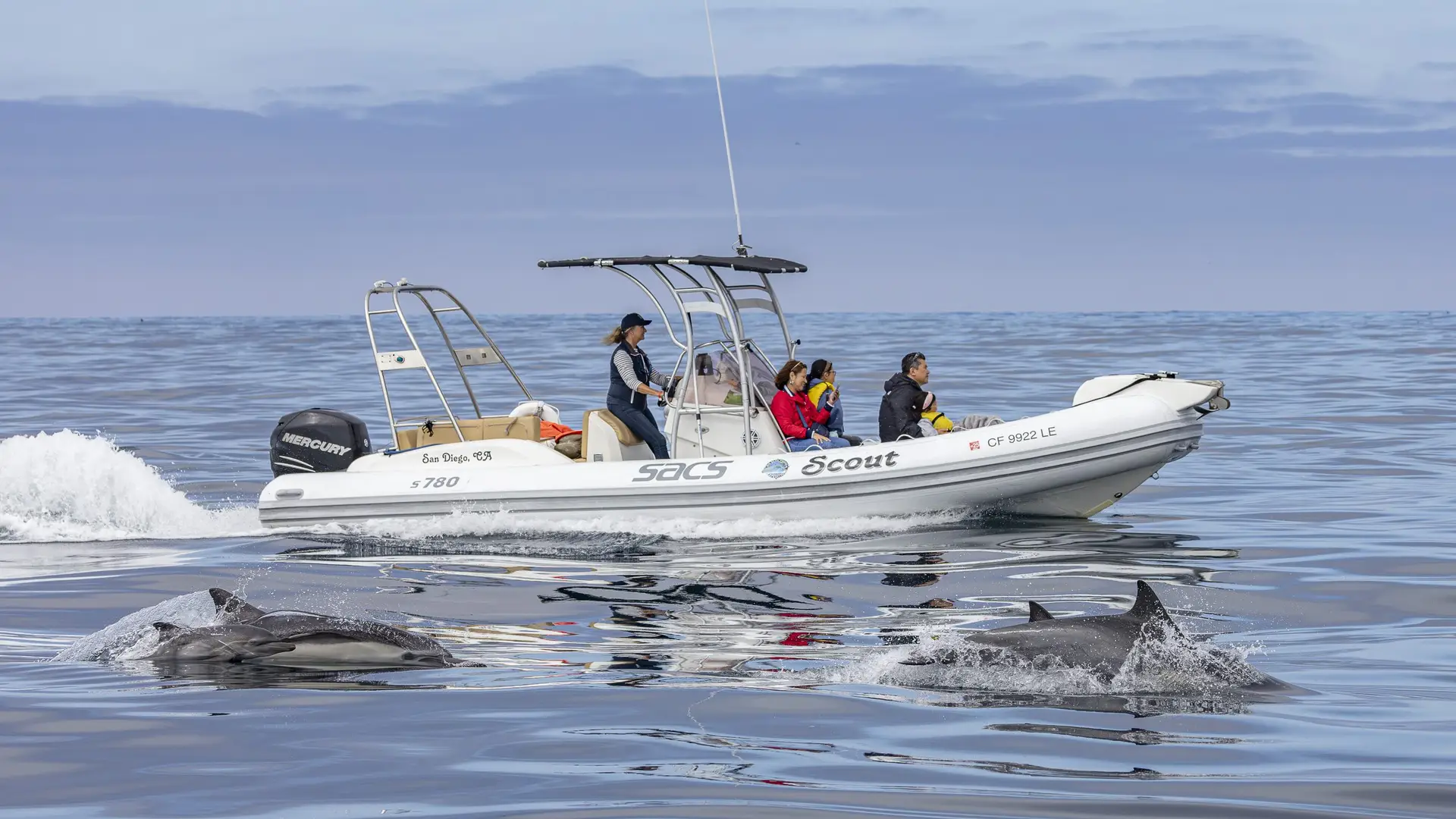
Common dolphins are typically the first dolphins we spot offshore San Diego. True to their name, thousands of these energetic animals constantly patrol the Pacific waters off our coast, and superpods numbering in the hundreds are not unusual. That said, these tiny speedsters — capable of bursts near 60 km/h (37 mph), making them the fastest of all dolphins — account for only a small slice of San Diego’s overall dolphin diversity.
We regularly see both short-beak (Delphinus delphis) and long-beak (Delphinus capensis) common dolphins on the same outing. Short-beaks are the smallest and fastest, at just 5–6 feet long, while long-beaks run larger at 6–8 feet. There’s some scientific debate over whether the two truly qualify as separate species; however, the long-beak’s striking hourglass pattern and signature “eye-shadow” marking make them easy for our crew to tell apart on sight.
Bottlenose Dolphins: Near Coastal to Offshore

Moving up in size, bottlenose dolphins (Tursiops truncatus) often make their first appearance right inside Mission Bay. These are highly social animals that form close-knit family bonds within their pods, similar in some ways to the multi-generational structure seen in elephant herds. While often friendly toward boats, a careful, patient approach works best with these near-shore residents, since they can grow shy after a day of heavy boat traffic.
Offshore bottlenose dolphins may technically be the same species as their coast-hugging neighbors, but they differ in noticeable ways. Specifically, they are typically 15–20% larger and darker than nearshore bottlenose dolphins, and they tend to be far more acrobatic. According to NOAA Fisheries, bottlenose dolphins are among the most studied marine mammals precisely because of this ecotype variation between coastal and offshore populations.
Like their nearshore counterparts, offshore bottlenose dolphins form supportive, tightly-knit families. We’ve personally seen seriously injured individuals — with damaged jaws and missing fins — go on to survive and thrive without issue. As a group, they work together to support every member of the pod. In this way, even dolphins grievously injured by orca attacks can go on to become thriving members of their community.

Risso’s Dolphins: Big, Deep-Diving, and Battle-Scarred

Risso’s dolphins (Grampus griseus) are typically the next-largest dolphins we see locally, often reaching 8–13 feet in length. Notably, Risso’s dolphins are instantly recognizable by their striking white-scarred skin. Their natural color is a dark charcoal gray, but a lifetime of deep-water hunting and social rough-housing leaves their bodies decorated in a maze of interweaving streaked scars — no two individuals look exactly alike.

Risso’s dolphins are known for diving thousands of feet in search of one of their favorite prey items: squid. In particular, the aggressive Humboldt squid uses a sharp, beaked mouth that can scrawl deep grooves into the bodies of these dolphins during a hunt. Fortunately, teamwork and thick blubber protect them, allowing Risso’s dolphins to tackle daunting prey without hesitation.
Orcas: The Largest and Most Powerful Dolphins on Earth

Not even Risso’s dolphins can compete with the largest dolphin of them all, the orca (Orcinus orca). While the common name “killer whale” suggests otherwise, orcas are in fact the largest members of the dolphin family, Delphinidae. As apex predators in every sense of the term, every orca visit to San Diego is electrifying for our guests. The individuals that visit us typically belong to the Eastern Tropical Pacific pod, a group that usually calls Baja California, Mexico home, and they specialize in hunting both dolphins and whales.
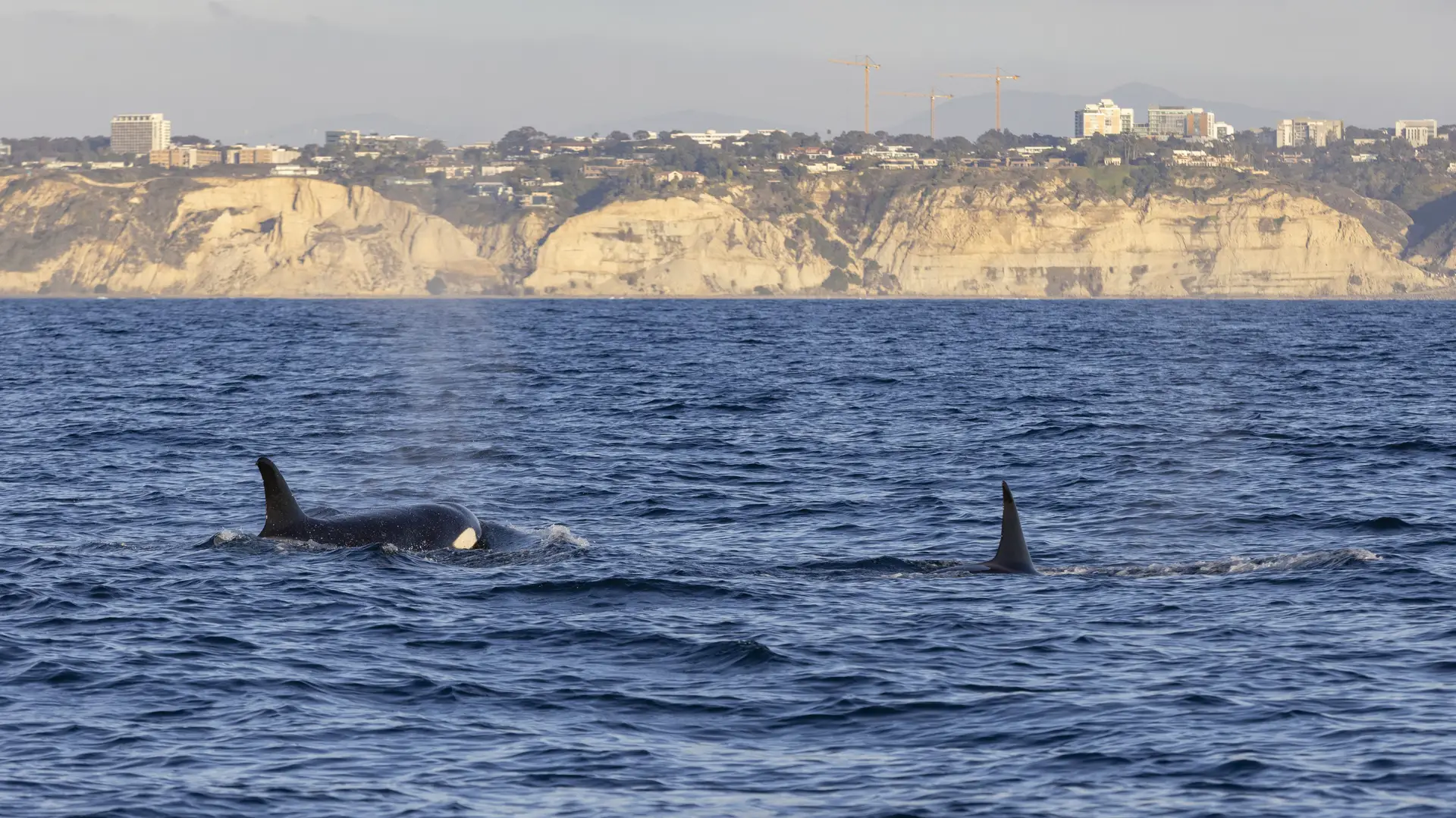
Orcas don’t have an official “season” off San Diego, but 2023–2025 has seen the Eastern Tropical Pacific pod visit consistently from right around Christmas through March. If you’re willing to try your luck, come join us for a dolphin-watching adventure during those winter months.
How Do Dolphins Communicate? Echolocation, Clicks, and Whistles
In addition to their physical differences, every dolphin species off San Diego relies on sound to navigate, hunt, and stay connected with its pod. Specifically, dolphins produce rapid clicking sounds that bounce off nearby objects, a biological sonar system known as echolocation. The returning echoes let a dolphin “see” the size, shape, speed, and even the internal structure of an object — including a fish hiding in murky water.
Beyond echolocation, dolphins also use signature whistles that function almost like a name. Each dolphin develops a unique whistle early in life, and pod mates learn to recognize it, calling out to specific individuals much like we’d call a friend by name across a crowded room. Similarly, body language — including tail slaps, breaches, and pectoral fin waves — carries meaning between individuals and, occasionally, toward curious boats like ours.
Dolphin Social Structure: Pods, Family Bonds, and Teamwork
Dolphins are fundamentally social animals, and their group structure — called a pod — can range from a handful of individuals to several hundred, depending on the species. Bottlenose dolphins tend to form smaller, tighter family units, whereas common dolphins often travel in massive superpods for safety in numbers. Meanwhile, orca pods are typically matrilineal, meaning offspring stay close to their mothers for life, a social structure documented extensively by researchers studying resident and transient populations along the Pacific coast.
Above all, cooperation defines dolphin society. Pod members babysit each other’s calves, support injured or sick individuals at the surface so they can breathe, and coordinate complex group hunting strategies. As a result, even a dolphin with a serious injury — like the broken-jawed bottlenose pictured above — can continue to thrive within a supportive pod.
What Do Dolphins Eat? Diet and Hunting Techniques
Diet varies considerably by species. Common and bottlenose dolphins primarily feed on schooling fish such as anchovies, sardines, and mackerel, often herding a bait ball into a tight circle before taking turns feeding through it. Risso’s dolphins, in contrast, specialize almost exclusively in deep-water squid, diving to depths of over 1,000 feet to find them. Orcas take hunting a step further, targeting other marine mammals — including dolphins, seals, and even whale calves — using coordinated pack strategies that resemble those of wolves on land.
Dolphin Reproduction, Calves, and Lifespan
Most dolphin species carry a single calf after a gestation period of roughly 11 to 12 months, and calves typically nurse for one to two years while learning essential survival skills from their mothers. Bottlenose dolphins can live 40 to 50 years in the wild, while orcas — the longest-lived dolphins — can survive 60 to 90 years, with older females often serving as pod leaders long after their reproductive years have ended. Therefore, a single pod can include several generations traveling, hunting, and raising calves together at once.
Dolphin Conservation Status: Threats Facing Wild Dolphins Today
While many dolphin populations remain stable, several face real and growing pressure. According to the IUCN Red List, threats to dolphins worldwide include accidental entanglement in fishing gear (bycatch), ocean pollution, vessel strikes, and the cascading effects of a changing climate on prey availability. Consequently, responsible wildlife-watching practices — including keeping a respectful distance and never feeding wild dolphins — play a meaningful role in reducing additional stress on these populations.
In particular, San Diego’s dolphins benefit from strong federal protections under the U.S. Marine Mammal Protection Act, which makes it illegal to harass, feed, or approach dolphins too closely. As a result, ethical boat operators maintain distance and let dolphins choose whether to approach the vessel, rather than the other way around.
Best Time and Place to See Dolphins in San Diego
Unlike many wildlife encounters that depend on a narrow migration window, dolphins can be spotted off San Diego throughout the entire year. Common dolphins appear almost daily, while bottlenose dolphins are especially reliable inside Mission Bay and along the immediate coastline. Risso’s dolphins tend to show up more consistently from late spring through fall, when squid populations move into deeper coastal canyons. For a closer look at sightings, seasonal patterns, and trip planning specific to our waters, visit our dedicated San Diego dolphins page.
How to Go Dolphin Watching in San Diego
- Choose a knowledgeable local operator. Book a trip with a crew that spends time on the water daily and understands current dolphin movement patterns, since local experience dramatically increases your odds of a close, ethical encounter.
- Pick your season strategically. Plan a trip between December and March if you specifically hope to see orcas, or head out any time of year if common and bottlenose dolphins are your primary goal.
- Bring the right gear. Pack polarized sunglasses, a hat, sunscreen, and a fully charged camera or phone, because dolphin encounters can happen suddenly and disappear within seconds.
- Stay patient and respectful on the water. Let the dolphins approach the boat on their own terms, avoid sudden movements or loud noises, and follow your captain’s guidance to protect both guests and wildlife throughout the trip.
What Our Guests Say About Watching Dolphins
Nothing communicates the magic of a San Diego dolphin encounter better than the guests who’ve experienced it firsthand. For example, you can read Carlos’s full account of his trip to see just how memorable an encounter with wild dolphins can be. Similarly, our Big Blue Photo Boat homepage features additional recent sightings and trip photos from the water.
Frequently Asked Questions About Dolphins
What is the best time of year to see dolphins in San Diego?
Common and bottlenose dolphins can be seen year-round off San Diego. However, if you’re hoping to spot orcas, the strongest window in recent years has run from late December through March.
How many species of dolphins live off the coast of San Diego?
San Diego waters regularly host four dolphin species — short-beak common, long-beak common, bottlenose, and Risso’s dolphins — plus seasonal visits from orcas, which are technically the largest dolphins in the world.
Are orcas really dolphins?
Yes. Despite the common name “killer whale,” orcas belong to the family Delphinidae, making them the largest species of dolphins on the planet.
How fast can dolphins swim?
Common dolphins, the fastest species found off San Diego, can reach bursts near 60 km/h (37 mph), while most other dolphins cruise comfortably between 3 and 10 mph.
Do dolphins in San Diego interact with boats?
Often, yes — particularly common and bottlenose dolphins, which will sometimes ride a boat’s bow wave. Still, a respectful, patient approach keeps these encounters positive for the dolphins.
What do dolphins eat in the wild?
Diet depends on the species: common and bottlenose dolphins primarily eat schooling fish, Risso’s dolphins specialize in deep-water squid, and orcas hunt larger marine mammals, including other dolphins and whales.
Final Thoughts on San Diego’s Dolphins
Ultimately, few coastal cities offer the sheer variety of dolphins that San Diego does, from lightning-fast common dolphins to battle-scarred Risso’s dolphins and the occasional visiting orca pod. Whether you’re planning your first trip or your fiftieth, understanding how these species differ — in size, diet, communication, and social structure — makes every encounter on the water more meaningful. So grab your camera, watch the weather, and come see San Diego’s dolphins for yourself.